Analytics

Wednesday, February 18, 2015

10 Common Mistakes Made When Starting Seeds Indoors

Right now it is February and indoor seed starting has begun for some of us.  I am a huge fan of seeds and seed starting and find great satisfaction in growing my own plants from seed.  I originally started my seed starting journey many years ago trying to start seeds inside with absolutely no luck so I focused my attention on wintersowing.  But then a couple of years ago I decided I didn't want to buy my annuals or herbs from the store any longer so I started indoor seed starting again.  With some trial and error and a lot of research I finally had success.  I now actually use my seed starting set up year round because it works so well for me.  Here is a post I did last year on Tips for Successful Seed Starting: http://sproutsandstuff.blogspot.com/2014/04/tips-for-successful-indooor-seed.html  With that success has also come mistakes and I am sharing them in this post and hope you can benefit from what I have learned along the way.
Herbs I started from seed indoors

So here is the list of the mistakes I made when I first started growing seeds inside:

1.  Wrong soil-this is probably the TOP issue there is.  Not any old soil will do for indoor seed starting.  Some are too heavy, some are too light, and most aren't sterile.  You need to use a sterile soil-less mix to be successful.  Look at the seed starting mixes used by the growers-they are usually a peat or coir based mix without any added compost or soil.  Read the "ingredients" when purchasing and avoid compost, soil, humus etc. in the mix.  I prefer (and have had wonderful results) using  Pro-Mix growing mix.  Seed starting soils that are not sterile can harbor insects and disease which will be hard to control once they start.
My preferred seeds starting mix by Pro-Mix

2.  An important issue that is easily overlooked is the issue of watering.  ALWAYS bottom water-by this I mean place water in a shallow container and then set your pots or trays in the water and allow the water to be absorbed into the soil.  When the soil becomes damp remove the pots or trays from the water and let drain so they do not sit in water.  Bottom watering helps in controlling fungus/disease related issues like damping off and mold.   Bottom watering also helps to control over-watering which also leads to disease issues.

3.  Using the wrong pots/containers or unsterilized pots/containers can cause serious issues for gardeners.  These issues are disease related.  Molds and fungus just love decaying material and when you use items like eggshells and paper that decompose you are inviting disease issues.  If you want to recycle use plastic containers from yogurt etc. for seed starting just make sure to clean them well with a bleach solution.  I personally just keep recycling my pots from previous years-washing them thoroughly before each use.   Also-I have never had any luck with peat pots or peat pellets.  They dry out too quickly and also can act as a "wick" pulling moisture from seedlings because of too much surface exposed to the air.
Dirty seed starter cell from last year that needs cleaned

Cleaning and sterilizing plastic pots from last year

Clean and sanitizing seed starting cell packs from last year

4.  Seedlings need light-not a little but a LOT.  Not enough light causes weak, lanky and leaning seedlings.  Make sure you give your seedlings plenty of light whether it is artificial or natural.  I prefer to use artificial light in the form of fluorescent shop lights-no need to spend money for fancy grow lights unless that is what you want to do.  I also reflect as much of the light back on to the plants as possible.  This also helps to prevent legginess and keeps the plants healthy and bushy.  My lighting system works well enough and provides enough light and warmth to keep my Agave and Sempervivums looking good all winter long.  I leave my lights on my plants between 12-15 hours a day to make sure they receive enough light to grow big and strong.
One of the fluorescent light fixtures I use
For plants use 1 warm and 1 cool fluorescent lights

For plants use 1 warm and 1 cool fluorescent lights
Reflecting the light helps keep plants bushy and prevents leaning

5.  Fertilizing.  Yes that can be an issue.  You do not need a seed starting mix with fertilizer-seedlings do not need fertilizer until they have their second set of true leaves-not before.  You don't feed your children if they aren't hungry so don't feed your seedlings until they need it.  Over fertilizing can build up in the soil, burn the seedlings or even cause too much growth.  More is not better!  Too little fertilizer can cause a host of problems such as discoloring of leaves, leaf curl, spotting etc. depending on the deficiency.  My recommendation is to apply a balanced, water soluble fertilizer at half the recommended strength every third watering.

6.  Planting depth.  Planting your seeds too deep or not planting them deep enough can cause issues.  Some very small seeds need light to germinate while others might need dark.  Issues related to planting depth can be: lack of germination, root development issues, and seed coat not falling off when seedling emerges.  When in doubt plant your seeds no deeper than their diameter.

7.  Not providing air circulation.  Another big issue.  Lack of air circulation can lead to disease issues, fungus gnats, and weak seedlings.  Run a fan on your seedlings for at least a few hours a day to help prevent these issues.

8.  Starting your seeds too early can also be an issue.  Sometimes we get so excited at the thought of Spring that we start our seeds too early.  If you have the space to take care of them as they get large then by all means start them whenever but if you have limited space and resources then don't start them too early.  The general rule is to start most seeds 4-6 weeks before the last frost date for your area. 
Basil started too early-had to harvest because it got too big

9.  Sowing too much (more than you need).  Boy does this happen.  Sure that entire package of Tomato seeds doesn't look like a lot but when they start growing look out!  If 50 seeds are in the pack and you plant them all and you have 50 percent germination you will have 25 tomato plants.  Unless you are a farmer you don't need that many.  Plus, they will take up a lot of room in your house.  All I am saying is take it easy and only plant as many as you need and save or trade the rest of the seeds.

10.  Not paying attention.  You can't plant seeds and walk away.  They are like children and need constant supervision in order to thrive.  Preventing pest and disease issues requires constant monitoring.  Once you see one plant keel over or one fungus gnat flying around you need to act quickly and the only way to do that is if you monitor.  Keep an eye on things so you know when they need watered, fed or isolated. 
Seedlings under lights

If you want to be successful at indoor seed starting remember to avoid making these mistakes that I have learned along the way.  If you have any questions or comments feel free to leave them below.

Happy Planting!
Rhonda

Tuesday, February 17, 2015

Use Scrap Wood to Make a Native Bee House

Honeybees get all of the attention, but the truth is we should be thinking more about our native pollinators-especially our native bees.  To do this we need to do a few things.  First, stop using chemicals in our yards and gardens.  Second, landscape with plants that attract and feed them.  Third, provide areas for shelter and nesting.  All of these things are pretty easy to achieve-even providing areas for shelter or nesting.  One way you can do this is by taking a log and drilling random holes in it and placing it somewhere in your landscape:
One way of building a native bee nest-holes in a log
Another way is by building them a home.  With a few scraps of untreated wood you can build a house for the native bees to nest in.  This is quick and easy and doesn't really require much skill (otherwise I would have never been able to do it).
For this project you will need a few things:

1.  Scrap wood-I used an untreated piece of 4x4 I had laying around but a 4x6 would be better-it should also be at least 6 in long and can be as long as you would like.  I have seen them 3 feet long.  You will also need a piece of wood for the roof-I used cedar shake.
Scrap wood

2.  A couple nails and a couple screws.
3.  A saw
4.  A drill and drill bits (drill bit size 1/4 to 5/16 in)

To begin building your house you need to first cut your 4x4 or 4x6 so that the top will have an angel (so water will run off).  I had a piece of wood that was bigger so I just cut it in half at an angle:
Make the cut at an angle
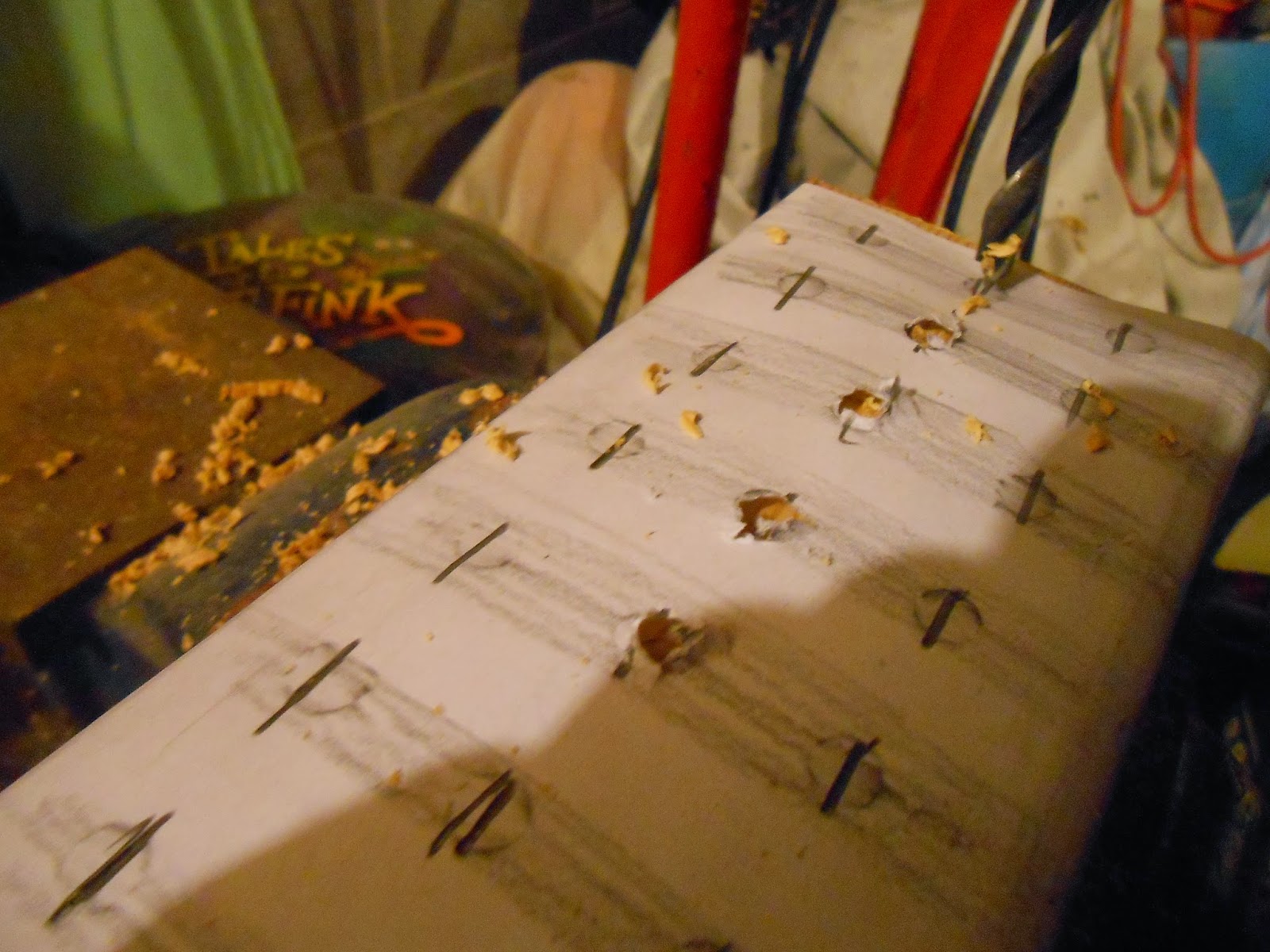
Next you need to begin drilling holes in the wood.  These should be at least 3 1/2 inches deep (5 1/2 would be better if your wood is thicker)-just be sure not to drill all the way through the wood.  I used 5/16 in drill bit for my holes.  You can make a random pattern of holes or you can use a template.  I used a pegboard as my template (copied it on to paper with pencil).
Peg board

Using pencil to transfer hole spacing on pegboard
Place paper over wood to use as a guide
Use the paper as a template for holes

Drilled holes in bee house
After you have drilled the holes you need to measure and cut the wood for the roof.  Have it overhang a little to give some protection from the rain.
Measure roof so it has an overhang
Attach the roof to the block using nails or screws.
Attach roof
After you have the roof attached you need to securely attach the hanger.  I used a soda can tab (works great) and screws.
Now it should be ready to take outside and hang.  A South or Southeast facing position is best.

I put it out now because the native bees will be out and nesting before you know it and I want to be prepared for them.  So try to get this or any other bee house out before March.

This is a cheap and easy project that you can do in minutes.  I think it looks pretty good considering my woodworking abilities.  Not only does this project reuse some of the wood leftover from other projects it also helps out my  native bee population. I hope you try this out and let me know how it works for you.

Happy Planting!
Rhonda

Saturday, January 31, 2015

Aquilegia (Columbine) is an Easy and Beautiful Perennial for the Garden

When someone asks me "what plant or flower do you have the most of in your garden" I always reply Aquilegia or what is commonly called Columbine.  To tell you the truth-I don't even know how many I have or even which ones I have.  I have been letting them self-seed and I also randomly throw down seeds and have been doing it for years now.   Since Aquilegia is probably the most adaptable and easiest to grow plant in my garden I encourage them to grow everywhere.
 
Patch of different Aquilegia growing in my garden
When I say easy and adaptable I mean it.  It will grow in dry shade under my pine trees or or in Full sun (zone 5) next to Lavender.  If you have a difficult area I suggest growing Aquilegia there.  Aquilegia has a taproot which makes it a beautiful drought tolerant plant and is often used in rock and alpine gardens.  It is perfectly hardy in zones 4-8.

White Aquilegia growing under pine trees
Aquilegia growing in full sun
There are some beautiful varieties out there-just about any color you can imagine!  White, yellow, pink, red, purple, black, bi colors, solid colors-you name it.

Purple and pink Aquilegia

Pale pink Aquilegia
They also have a variety of flower forms-singles, doubles, short spurs, long spurs, without spurs.
Aquilegia chrysantha with long spurs

White Aquilegia (no id)  without spurs
They are super easy from seed-in fact all of mine have come from seed.  Don't waste your money buying a plant because Aquilegias are a short-lived perennial.  Instead grow them from seed-you can buy seed packets from various retailers or just ask another gardener to share.  I have received many seeds from other gardeners.  One note though-Aquilegia hybridize readily so they may or may not look like the mother plant.  I personally enjoy the surprise I get growing them from seed but if you want true "named" varieties buy the seed packets from the store. Sow seeds or allow them to self-sow every year to ensure you always have the plant around.
Aquilegia vulgaris "Black Barlow"

Aquilegia "Winky Series"
One bonus I truly appreciate in this plant is deer and rabbit resistant.  I have a serious rabbit problem and this is one of my plants they avoid nibbling.  Squirrels and deer stay away from it too!  If you have any of these animal  problems this is a must for your garden!
Purple Aquilegia
 If you are looking to plant for pollinators Aquilegia is a must.  It attracts bees as well as Hummingbirds to it's flowers.  In my garden the hummingbird favorite seems to be my native Aquilegia canadensis but they do visit the others throughout my gardens and the bees don't seem to have a favorite.  The go from on to another without regards to color or style.
Aquilegia canadensis
Aquilegia bloom throughout much of the month of May-but my Aquilegia "Tequila Sunrise" has an extremely long bloom time for the species blooming from May well into the month of June.
My longest blooming variety-Aquilegia "Tequila Sunrise"
I have to admit that this plant is not without it's problems.  Leaf miners usually attack my plants every year.  It does not harm the plant-it just cause the leaves to look funny.  Aphids and spider mites can also be a problem.  They also will usually not kill the plant but may cause leaves or flowers to become distorted.  Mildew will surface on it's leaves from time to time-but this also will not kill the plant.  My solution to all of these problems is not chemicals but to just cut the entire plant down to the crown and throw away (do not compost it).  The plant will send up a new flush of leaves in no time and will look good as new. 

Aquilegia do not need any help in the form of fertilizer.  I do not fertilize the plants in my garden and they bloom beautifully so save that Miracle Grow for your other plants.  The only nutrients my plants receive are those provided by my mulch layer breaking down or a rabbit pooping in the area. 
White Aquilegia
I hope this post has given you some incentive to grow this very beautiful and useful plant in your gardens.  They are an easy and wonderful addition to your garden and you will not be disappointed!   Here are some more varieties to encourage you:
Purple/Blue Aquilegia
White Aquilegia
Pink Aquilegia
Purple Aquilegia

Pink Aquilegia
Purple Aquilegia
Thanks for stopping by and if you have any questions or comments feel free to leave them below.  As always:

Happy planting!
Rhonda

Thursday, January 15, 2015

Tips for Feeding Wild Birds

Feeding birds has always been a hobby of mine-I have been doing it for years now and nothing entertains me more than watching the birds feeding.  I get rewarded with their antics and their activities and even when I am crabby they make me smile.  And nothing tops a visit from a bird that is uncommon in my area.  Bird feeding is a rewarding hobby and if you follow these tips it will be rewarding for your feathered friends. 

1.  Place feeders in different areas of your yard and garden-this will give all the birds an opportunity to eat not just the "bully" birds like Jays and Starlings.

2.  Provide water year round.  I even provide water in winter with this heated birdbath.  The birds share it with the other animals that use it.

Heated birdbath

3.  Be consistent if you wish to keep having them return.  Don't let your feeders remain empty for a long time between fillings


4.  Have a variety of feeder types available.  I have very hungry squirrels in my yard so I have feeders that are "squirrel proof".  There are many types available including hanging, platform, tube, suet, and "sock" feeders. 

Hanging squirrel resistant feeders
Squirrel resistant feeder on a pole

Platform feeder slightly off of the ground
5.  Don't forget the ground feeders!  Birds like Juncos and Turtle Doves prefer to feed on the ground-I usually just throw some down for them under the feeder.  I also do this to keep the squirrels from trying to get at the other feeders.  It usually helps:-))

Birdseed for ground feeders
6.  When choosing a birdseed or a mix don't waste your money on "cheap" birdseed or birdseed that contains a lot of fillers especially Milo and wheat.  Very few birds will eat it unless they are starving and it will end up growing under your feeder.  Look at the ingredients on the bag: 
Milo should not be the first ingredient in birdseed
This birdseed has a good mix of ingredients-notice no milo
This birdseed mix is good for Finches-notice no milo
Don't buy "flavored" birdseed-it is usually artificial and is unnecessary to attract the birds.  I have accidentally purchased the "berry" flavored and it made no difference.  I really don't think they care.
Another waste of money is safflower-it is expensive and I have never had any of my birds prefer it.  If you have an issue with squirrels your best bet is with a squirrel proof feeder. If you want the best all-around bird seed choose black oil sunflower.  It appeals to the widest variety of birds including Woodpeckers, Finches, Cardinals, Titmice and Chickadees.  You can usually find it on sale and it can be cheaper than most of the mixes.
50 lb bag of Black Oil sunflower seeds
Other foods you can provide:  suet, mealy worms or bugs, peanuts (unsalted), peanut butter and whole corn. Do not feed your birds processed foods such as white bread, cakes, donuts, etc.  These contain additives and chemicals that aren't good for us let alone wildlife.  It will also attract unwanted pests like rats and mice and also less desirable birds such as crows and starlings to your yard.

7.  Provide cover for them to fly into to escape potential predators.  Shrubs and trees will provide the safety they need to feel better.

8.  Leave seed heads of some of your plants and flowers standing in the Fall and Winter.  Plants like Agastache, Rudbeckia, and Echinacea provide another food option for the birds.  You can also plant shrubs and trees that provide nuts and berries to provide food for them.

9.  Keep it clean!  Keep your feeders and birdbaths clean to help prevent the spread of diseases that might potentially make the birds sick.  Also throw away any seed that has gotten moldy from being wet.  Do not leave it in the feeder.  Clean up around the bottom of your feeders to remove the hulls from the seed and occasionally move your feeders to keep the area below clean for the ground feeders.  Here are a few pics of my visitors:


10.  Enjoy them!  I hang a few feeders outside my windows so I can watch them feed especially in the morning when I am drinking my coffee.  It is better than TV.

Northern Cardinal at feeder

Turtle Dove

Turtle Dove junco and Sparrow

Blue Jay
If you have any questions, comments or suggestions feel free to leave them below.

Until next time-Happy Planting!

Rhonda