Analytics

Tuesday, September 9, 2014

Recycle a Flat Basketball to Create a Hypertufa Garden Orb

Hypertufa garden orb
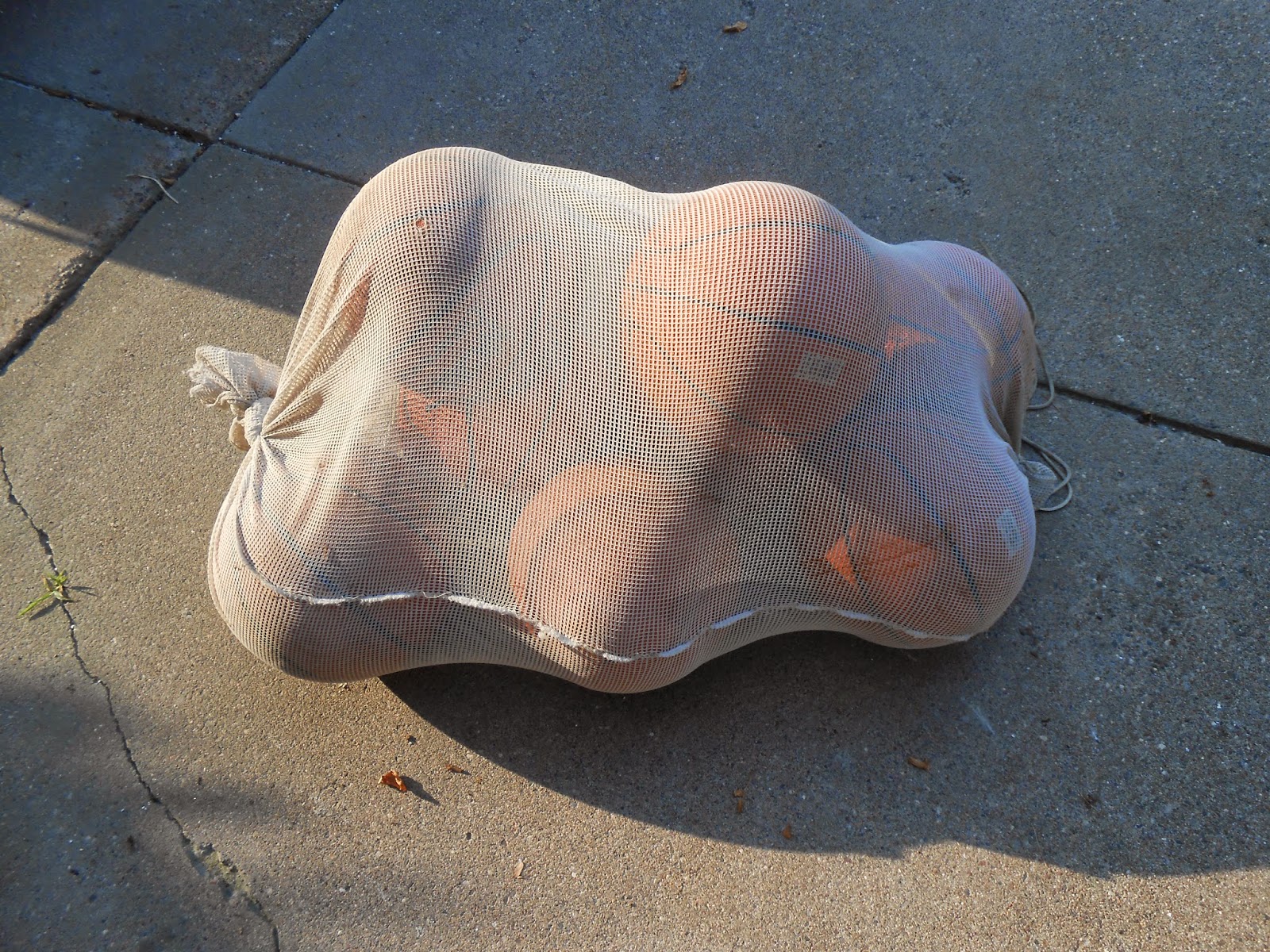
I admit it-I watch for interesting stuff to be thrown away by my neighbors.  Who doesn't?  This usually leads to me picking up some items which my family dubs totally useless.  One example would be the bag of flat basketballs my next door neighbor threw out in the trash.  Here they are:
flat basketballs as molds for hypertufa orbs
Useless?  I think not.  They make the perfect mold to create hypertufa garden orbs and better yet they are free.  Sure-you can go and buy glass lighting fixtures.  But why do that when you can use something free (and safer)?

I use hypertufa for this post but you can use your favorite concrete mix for these.  In fact I made a concrete orb with one of the flat basketballs.  It is way heavier than the hypertufa.  Use which ever you prefer.  That is the best part of creating these-you can adjust the directions for your taste and preferences.

For this project you will need:
1.  Your favorite hypertufa recipe or concrete mix.  Also gloves and a mask.
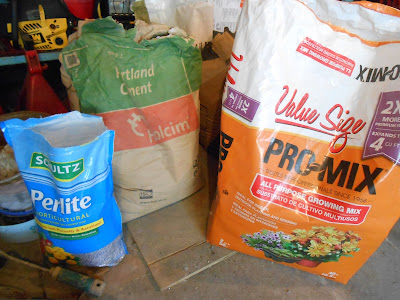
Hypertufa ingredients
2.  A flat basketball.
3.  A bowl or container filled with wet sand (to keep the basketball round).
4.  An aired up basketball or other round item to make an impression in the sand.

5.  A plastic grocery sack to cure the hypertufa orb in.

6.  A pair of scissors.

That's it!  So now let's get busy creating:-))

1.  Using the aired up basketball make an impression in the bowl of sand for the flat basketball to sit in.  You want it to be rounded so you don't end up with a flat sided basketball.  Unless you don't mind-then you can just leave the sand as is.
2.    Look for the fill plug on the basketball and have it facing up like this:
3.  Now you are going to take your scissors and cut an opening around the plug.  You only need a hole large enough for your hand to fit in.  Also leave the flap attached:
4.  Set the flat basketball in the impression in the sand.  You are now ready to mix your hypertufa (or concrete). 
5.  Begin mixing your hypertufa (or concrete).  There are some good recipes online for hypertufa but if you can't find one here is my recipe:
1 part portland cement
1 1/2 parts Pro-Mix All Purpose Growers Mix
1 1/2 part perlite
A handful of concrete reinforcing fibers
You will notice that I use Pro-Mix instead of peat moss.  Yes it works-I do not have a need for a bag of peat moss so I use what I have.  Pro-Mix works perfectly!
Water as needed
The hypertufa should be about the consistency of oatmeal-when you squeeze a small ball of it in your hand only a few drops of water should come out.  Do not add too much water-it will make a weak product!  Let your hypertufa sit for about 10 minutes to hydrate before you begin filling.

6.  Begin filling your basketball-press the hypertufa down inside the basketball as you fill.
7.  After you have filled your basketball let it sit for 24-48 hours.  It should begin to harden in 24 hours but I do not unmold for 48 hours.
8.  If it has hardened begin cutting the basketball off of the orb.  Use sharp scissors:-))
9.  After you have "unmolded" the orb you can take a knife and scrape off the excess that is around the fill hole.  I use an old steak knife for this.  You can also take a wire brush and rough up around the outside of the orb if you would like.  I don't do that myself but I know some hypertufa people do it.
Hose it off:
10.  Now wrap the orb in the plastic grocery sack and set in the shade for a week or two so that it can cure.  Check it daily and mist with water so it doesn't dry out.
curing hypertufa garden orb
Curing hypertufa
11.  After it has cured set it out in the garden-after it has been out there a while it will start to form moss on it.  I might use the buttermilk mixture to start the moss growing-I am impatient:-))
Hypertufa garden orb
I made three of these orbs for my garden and I still have plenty of basketballs left to make more.  I love how they look under the Hosta and can not wait for them to grow some moss.  For a really cool look I might make another one with concrete and mosaic the outside of it.  That would be so awesome looking!

Hope you enjoyed this post and remember to use your own creativity to make it your own.  As with all my projects you can change it up for your own taste.

Until next time-Happy Planting!

Rhonda


Thursday, September 4, 2014

A Different Kind of Clematis: Clematis stans

Clematis stans
This is the time of year (late Summer/Early Fall) I get to admire the dainty little blooms on my Clematis.  Not just your average climbing Clematis but a delightful shrubby Clematis native to Japan.  It is called Clematis stans and it is a very easy Clematis to grow.  I enjoy this plant so much I have about 8 growing in different garden areas in my backyard.  It is highly adaptable growing in dry shade directly under my pines, in a moist area under a maple, and even in an average situation under a Prunus serotina.  Now mind you the leaves on the plants in the drier areas do have a tendency to get crispy around the edges, but I don't mind.  This Clematis requires minimal pruning-if  the winter (or rabbits in my case) doesn't take care of it then just prune it close to the ground in early Spring before it breaks bud.  Clematis stans can reach 3 feet tall (sometimes 4 feet) but usually needs no staking.
Here is a pic of my tallest one:
Clematis stans

Here are a couple more growing in my garden:
Clematis stans
Clematis stans


Here is a better shot of the little bell shaped flowers:
Clematis stans

Clematis stans is easy to propagate from seeds.  In fact, I was lucky enough to have received seeds for this plant from a very generous gardener a few years ago and have since passed on seeds to others.  My original plants were grown via wintersowing the others were started by me tossing seeds here and there in the Fall.  If you are not into seed starting I am sure you can locate this plant on line from one of the many online plant retailers or maybe even at your local nursery.  If you see one buy it-I highly recommend this plant for your garden!

Here are some basics for you if you would like to grow this lovely plant:

Clematis stans
Height:  24-48 inches
Spacing:  24-36 inches
Hardiness:  4b-9b (?-sources are different on hardiness)
Sun exposure:  full sun (in the north) to shade (mine grow in full to dappled shade)
Water:  Average water needs
Pruning group:  3 (Summer/Fall bloomer)
Another bonus:  this plant attracts both bees and hummingbirds

I hope I encouraged you to grow this uncommon Clematis in your garden-it is definitely worth the space:-))

Until next time-Happy Planting!

Rhonda


Friday, August 22, 2014

DIY Copper Garden Art from Copper Tubing

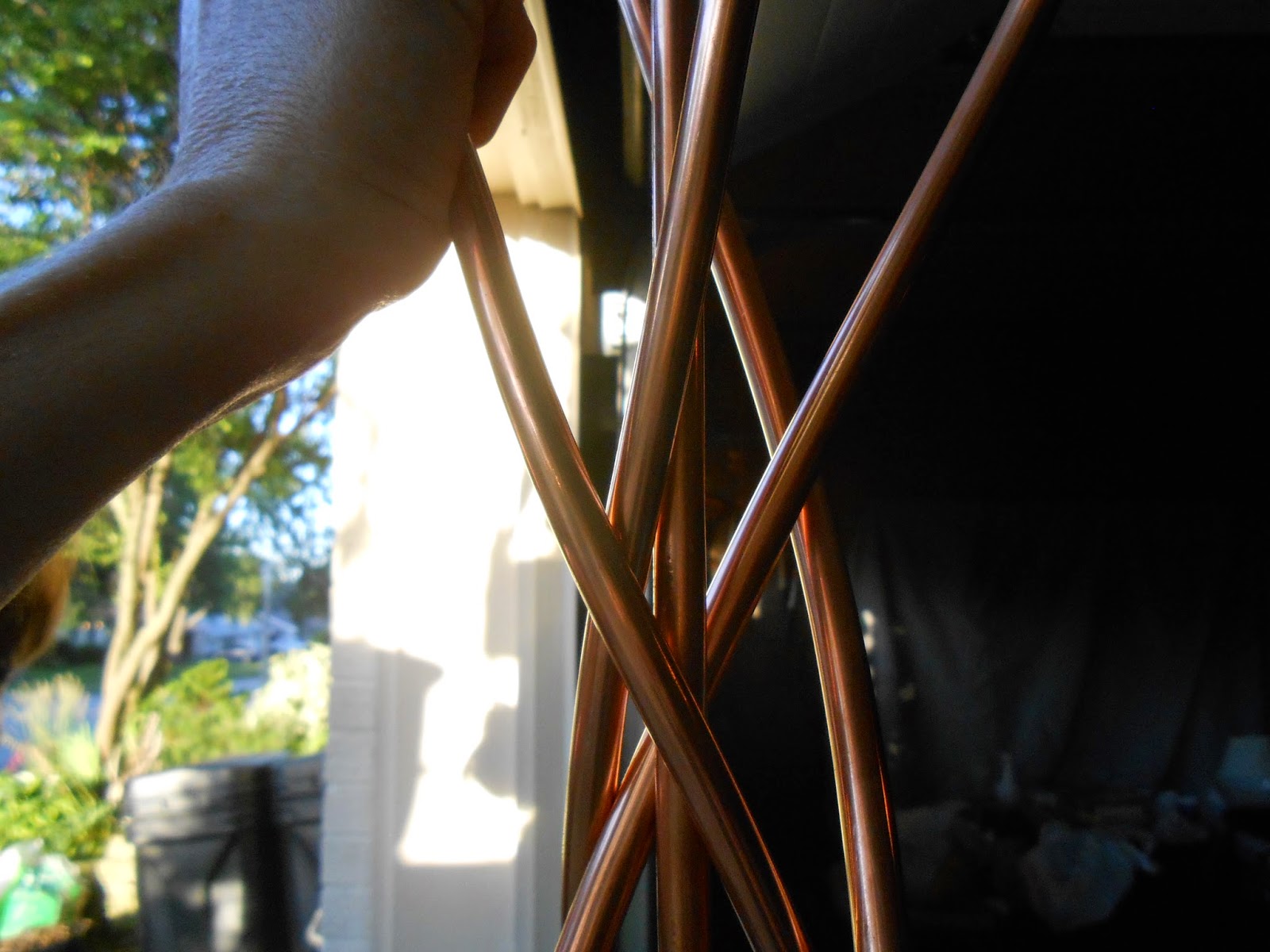
I love the look of copper in the garden-so much so that I have made a few different pieces for my garden and also a rain chain.  I like to use copper tubing because it is flexible and I can manipulate it any way that I want.  The added bonus is that it is beautiful and elegant.

I created this recently from a roll of copper tubing, some concrete and an old nursery pot:
DIY copper garden art

Here is another piece I made last year:
DIY copper garden art
 Here is a picture of the first one I created a few years ago:
DIY copper garden art
These pieces of garden art are extremely easy to create-you just need to use your imagination and find your artistic side.

In this post I will show you how I created my newest addition to my garden so that you can go out there and create one for your garden.

For this project you will need:
1.  An old nursery pot (I think this is a 3 gallon size) and a roll of duct tape.
2.  A bag of concrete mix-any will do.  I use Quikrete.  Also a tub to mix the concrete in.
3.  A roll of copper tubing (I picked this one up at Menards it is enough for a couple of projects)
4.  A pair of tin snips or pipe cutter.
5.  A tape measure (optional)

Here are the steps to create your garden art:

1.  Use the duct tape to cover the holes in the bottom of the nursery pot like this:
2.  Roll out the tubing and cut into the length you desire.  For mine I cut them into 6 foot lengths.  Just a note-I like to work in odd numbers so I cut 5 lengths for this project.
3.  Mix up the bag of concrete according to the package directions.
4.  Let the concrete sit for a few minutes to hydrate then add to the nursery container.
5.  Let the concrete sit for a few minutes then start inserting the copper tubing into the concrete like this:
6.  In order to hold the tubing in place I use a nylon tie at the top:
7.  Let sit for a week (if you use regular concrete) to cure.
8.  After the concrete has cured you can cut the nylon tie:
9.  Use your hands to gently bend and guide the tubing-do not bend to sharply.  This will cause a crimp.  Always bend slowly. 


Now start on the next one:
Just continue to bend each piece to achieve the look you want.  Just remember that this is your piece of art-it does not need to be perfect.

Almost done:
After I had it the way I wanted it I did solder a few of the areas together just to be sure it was sturdy:
You will also notice that it started to patina-I did this treatment before I put it in the garden so I wouldn't kill or damage any plants.  If you want to keep the copper color you might want to seal it.

10.  Cut off the pot.

11.  Find a spot in your garden:
12. Dig a hole and plant your piece of art:
12.  Sit back and enjoy your own piece of art:-))
DIY copper garden art
I hope you try this project out-you can create your own original art work that you will love and your neighbors will admire.  And of course it was easy!

Until next time-Happy Planting!

Rhonda